...but I thought I'd post a few things I recently read.
The Chicago Reader takes on neocon bogyman Leo Strauss, showing him not to be the granddaddy of the neoconservative movement that people make him out to be. Having taken a course on Strauss at Dal, it's something that I agree with - at the most his disciples have taken his philosophical works as political, something that is interesting given his explicit idea of separation between the philosopher and the polis.
Even cooler though, is an article from The New Republic on a trio of political psychologists who have been studying the effects of bringing up morality on the people's political behaviour. Apparently you get more conservative and hate outsiders more, which could explain much about American politics since 9/11.
Finally, a speech given to the APA about gender roles entitled, 'Is there anything good about men?'- one that will undoubtedly spark controversy, especially with its idea that men created culture through their superior extended networking abilities. An interesting read overall.
Tuesday, September 04, 2007


Wednesday, May 30, 2007
Problems in Eastern Europe
Der Spiegel has put together a couple of stories about the political problems, corruption, and the rising influence of extreme political views facing several Eastern European countries. As a perfect example of some of these problems, in Russia gay rights activists were beaten up by neo-Nazi's while the police watched, bearing signs such as 'Death to Gays'. To make things worse, the police then went in and arrested the activists, leaving the neo-Nazi's alone. A couple days later, another British official was assaulted after giving a talk on globalisation. Mayors of major European cities decried the violence.
Astronomers have discovered another 28 exoplanets, taking the overall known total to 236 and demonstrating advances in technique that should make it easier to find even more. They are also watching 2 suns orbiting each other that could soon (and that's a relative term) combine to form a 'supersun' 100 times larger than our own. In biology, scientists working on the genome project have identified 6 variations in the genetic code that increase the risk of breast cancer.
Also:
- The first creationist museum has opened in Kentucky.
- USA Today looks at the long history of resistance to science in the US.
- Obama has put forward his health care plan.
Astronomers have discovered another 28 exoplanets, taking the overall known total to 236 and demonstrating advances in technique that should make it easier to find even more. They are also watching 2 suns orbiting each other that could soon (and that's a relative term) combine to form a 'supersun' 100 times larger than our own. In biology, scientists working on the genome project have identified 6 variations in the genetic code that increase the risk of breast cancer.
Also:
- The first creationist museum has opened in Kentucky.
- USA Today looks at the long history of resistance to science in the US.
- Obama has put forward his health care plan.
Sunday, May 20, 2007
Who needs political freedom when you have oil?
In what is becoming a common occurrence, Russia detained more than a dozen opposition leaders who threatened to protest in the provincial city of Samara. Apparently the reasons for the detention according to Putin's government were to ensure the 'authenticity of their airline tickets,' and had nothing to do with the protest itself. This comes a week after authorities raided the local newspaper, once again ostensibly because of 'potential software violations.' Since this is only one of many problems with human rights going on in Russia, the CSM featured a piece from a member of the Russian Duma whose party has been banned, who presented an overview of the sheer scale of the loss of political freedoms in Russia. Also, Frontline examines the Russian government's attacks on independent media.
This act obviously complicates the relationship between Russia and the EU, and German newspapers had much to say about the relationship between the two. Of course, the recent electronic attacks against Estonia, reportedly coming from Russian government sources, only demonstrates the caution is required when dealing with Russian affairs. As a measure to guard against future economic dependency on Russia, the EU is looking into constructing another pipeline to deliver gas to Europe.
In France, Sarkozy is sworn in as the new President. Spiegel looks at what this means for Europe, while the New York Times looks at his surprising choice of left-wing Bernard Kouchner as France's new Foreign Minister.
Astronomers must have been working overtime this week - some found that the solar system is likely to be relegated to a sparse area of space after the collision between our galaxy and the Andromeda galaxy - in 3 1/2 billion years. They also discovered an extra-solar planet whose surface might completely covered in of water. Astronomers finally found evidence of a dark matter ring, accompanied by a pretty amazing photograph.
Also:
- Christopher Hitchen's scathing scathing take on the life of Jerry Falwell.
- Explaining the origins of 'white trash'.
- Christina Hoff Sommers on the lack of engagement the American feminist movement has with the oppression of women in Islamic countries.
- Turkey, Islamic parties, the EU and the legacy of Atatürk.
- An argument for the increasing irrelevance of the Middle East in Western foreign policy.
- The CSM on Africa's lack of action over Mugabe.
This act obviously complicates the relationship between Russia and the EU, and German newspapers had much to say about the relationship between the two. Of course, the recent electronic attacks against Estonia, reportedly coming from Russian government sources, only demonstrates the caution is required when dealing with Russian affairs. As a measure to guard against future economic dependency on Russia, the EU is looking into constructing another pipeline to deliver gas to Europe.
In France, Sarkozy is sworn in as the new President. Spiegel looks at what this means for Europe, while the New York Times looks at his surprising choice of left-wing Bernard Kouchner as France's new Foreign Minister.
Astronomers must have been working overtime this week - some found that the solar system is likely to be relegated to a sparse area of space after the collision between our galaxy and the Andromeda galaxy - in 3 1/2 billion years. They also discovered an extra-solar planet whose surface might completely covered in of water. Astronomers finally found evidence of a dark matter ring, accompanied by a pretty amazing photograph.
Also:
- Christopher Hitchen's scathing scathing take on the life of Jerry Falwell.
- Explaining the origins of 'white trash'.
- Christina Hoff Sommers on the lack of engagement the American feminist movement has with the oppression of women in Islamic countries.
- Turkey, Islamic parties, the EU and the legacy of Atatürk.
- An argument for the increasing irrelevance of the Middle East in Western foreign policy.
- The CSM on Africa's lack of action over Mugabe.
Saturday, April 21, 2007
Vivre la Démocratie!
Tomorrow is the big day! France goes to the polls for the 1st round of balloting to elect the next President of the 5th Republic. In a race widely seen to be a dive to the centre (or right) for the top three candidates, the media has a whole pile of goodies out there, for instance, about the pragmatic voter, the endemic economic and racial problems in the banlieues, straight-up overviews the candidates, or focusing on the frontrunner's book. The election itself is a tossup with 40% of those polled still undecided, so it should make for an interesting election night.
Russian police beat down a bunch of protesters this week as 2,000 protesters met 9,000 riot police in St. Petersburg. Given the size of the crackdown, Spiegel asks an important question: what exactly is Putin afraid of? Russian police held and questioned former world-champion chess player Kasparov about comments he made on a radio programme, attempting to gather evidence to charge him with making 'extremist' remarks against the government. Slate compares this protest with the protests that are going on in the Ukraine. And you wonder why Britain gave opposition figure Boris Berezovsky political asylum.
Putin's government shut down a media foundation after a police raid because its President didn't declare some currency she brought back from the EU - apparently the private actions of an executive member is enough to bring everything to a stop. It's not all about the political freedoms either. Russia is making it much more difficult for Westerners to adopt children from orphanages, despite the large demand - 260,000 children are considered available for adoption in Russia. Adoption agencies, who helped place almost 7,000 children last year, are facing a dramatic increase in the amount of bureaucracy to reapply for their status this year. Finally, the trust between the EU and Russia is at a very low level, although the main issue here is whether Russia can provide a constant natural gas supply.
Couple of interesting science stories out there this week. The results of Gravity Probe B scores another victory for Einstein. Astronomers have found that big ass stars are really bad for planetary formation. Speaking of stars, our own sun has recently found to have musical potential. In a page directly out of sci-fi, some are speculating that deflector shields could be used to protect future astronauts from radiation. Oh, and looking for a new way to explore other planets? Why not try smart dust!
Also:
- Yay! No more limbo!
- If I haven't said it before, animal rights activists are seriously crazy.
- One Tory MP is looking to censor the internet in Canada.
- Slate argues for promiscuity.
- A 1,400 year-old business files for bankruptcy.
- What is Stephen Harper Reading?
- Women do more work overall then men, right? The empirical data is in, and in the West, it's actually a tie.
Russian police beat down a bunch of protesters this week as 2,000 protesters met 9,000 riot police in St. Petersburg. Given the size of the crackdown, Spiegel asks an important question: what exactly is Putin afraid of? Russian police held and questioned former world-champion chess player Kasparov about comments he made on a radio programme, attempting to gather evidence to charge him with making 'extremist' remarks against the government. Slate compares this protest with the protests that are going on in the Ukraine. And you wonder why Britain gave opposition figure Boris Berezovsky political asylum.
Putin's government shut down a media foundation after a police raid because its President didn't declare some currency she brought back from the EU - apparently the private actions of an executive member is enough to bring everything to a stop. It's not all about the political freedoms either. Russia is making it much more difficult for Westerners to adopt children from orphanages, despite the large demand - 260,000 children are considered available for adoption in Russia. Adoption agencies, who helped place almost 7,000 children last year, are facing a dramatic increase in the amount of bureaucracy to reapply for their status this year. Finally, the trust between the EU and Russia is at a very low level, although the main issue here is whether Russia can provide a constant natural gas supply.
Couple of interesting science stories out there this week. The results of Gravity Probe B scores another victory for Einstein. Astronomers have found that big ass stars are really bad for planetary formation. Speaking of stars, our own sun has recently found to have musical potential. In a page directly out of sci-fi, some are speculating that deflector shields could be used to protect future astronauts from radiation. Oh, and looking for a new way to explore other planets? Why not try smart dust!
Also:
- Yay! No more limbo!
- If I haven't said it before, animal rights activists are seriously crazy.
- One Tory MP is looking to censor the internet in Canada.
- Slate argues for promiscuity.
- A 1,400 year-old business files for bankruptcy.
- What is Stephen Harper Reading?
- Women do more work overall then men, right? The empirical data is in, and in the West, it's actually a tie.
Saturday, April 14, 2007
Wolfowitz in Hot Water
Paul Wolfowitz, noted neocon and recent head of the World Bank, has come under fire for giving his partner a promotion and large pay raise without the approval of the executive board. The New York Times explores the background to the scandal, especially given the relationship between the United States and the rest of the West.
You should check out this documentary entitled 'Death of a Nation' - it overviews the demographic crisis that Russia is currently facing, and how it plays into xenophobic attitudes toward those ethnic groups seen to be having many children. The part with the Cossacks is particularly frightening. On a similar topic, Russia has banned all immigrant vendors from working - even those who are legal immigrants. Now that only ethnic 'Russians' can sell goods, the people are paying the economic cost of that decision in higher prices and shortages. Oh, and if you want to protest this legislation, you should think twice. A key opposition leader, Garry Kasparov, has been arrested after attempting to organise a rally against the Putin regime.
Also:
- Slate overviews the French Presidential election.
- Spiegel published the results of a Dutch study on European Islamic terrorism.
- The White House 'accidentally' lost millions of emails, many of which could have been used in proving Republican wrongdoing.
- 13 detainees at Guantanamo Bay are being force-fed.
- If you have Google Earth, check out their new coverage of Darfur.
- The CSM gives great coverage of how Chiquita had Columbian paramilitaries on salary.
- Who killed JFK? Apparently a French assassin hired by LBJ.
- You can now listen to the 2007 Reith Lectures, delivered this year by Jeffrey Sachs.
- Which came first, the chicken or the Tyrannosaurus Rex?
- The Mozart effect is just a placebo.
- Do we really need 8 hours of sleep?
- The hardest Super Mario level... ever... (he never finishes 1-2, so you can stop after 1-1)
You should check out this documentary entitled 'Death of a Nation' - it overviews the demographic crisis that Russia is currently facing, and how it plays into xenophobic attitudes toward those ethnic groups seen to be having many children. The part with the Cossacks is particularly frightening. On a similar topic, Russia has banned all immigrant vendors from working - even those who are legal immigrants. Now that only ethnic 'Russians' can sell goods, the people are paying the economic cost of that decision in higher prices and shortages. Oh, and if you want to protest this legislation, you should think twice. A key opposition leader, Garry Kasparov, has been arrested after attempting to organise a rally against the Putin regime.
Also:
- Slate overviews the French Presidential election.
- Spiegel published the results of a Dutch study on European Islamic terrorism.
- The White House 'accidentally' lost millions of emails, many of which could have been used in proving Republican wrongdoing.
- 13 detainees at Guantanamo Bay are being force-fed.
- If you have Google Earth, check out their new coverage of Darfur.
- The CSM gives great coverage of how Chiquita had Columbian paramilitaries on salary.
- Who killed JFK? Apparently a French assassin hired by LBJ.
- You can now listen to the 2007 Reith Lectures, delivered this year by Jeffrey Sachs.
- Which came first, the chicken or the Tyrannosaurus Rex?
- The Mozart effect is just a placebo.
- Do we really need 8 hours of sleep?
- The hardest Super Mario level... ever... (he never finishes 1-2, so you can stop after 1-1)
Monday, April 02, 2007
I'm Coming Back!
Yeah, it's been a while since the last post. PhD's, shockingly, take a lot of work. I'm over the big hump for the month though, so watch this space for something new. ;)
Sunday, February 11, 2007
It's for Real Now!
Barrack Obama launches his Presidential Campaign. Nuff said.
Also:
- Ségolène Royal releases her manifesto for the French Presidency. A few highlights.
- Johns Hopkins Magazine reviews a study looking into post-war Iraqi mortality rates.
- A good review of Kurdish politics.
- Canadian PM Harper blasts back at China's veiled economic threats for discussing the dismal Chinese human rights policy.
- Der Spiegel on the conflict between Turkish nationalists and liberals.
- The United Nations takes on Haitian street gangs.
- Professional dogfighting is on the rise in Russia.
- The genetics of type 2 diabetes is mapped out.
- Is the black hole in the middle of our galaxy the ultimate particle accelerator?
Also:
- Ségolène Royal releases her manifesto for the French Presidency. A few highlights.
- Johns Hopkins Magazine reviews a study looking into post-war Iraqi mortality rates.
- A good review of Kurdish politics.
- Canadian PM Harper blasts back at China's veiled economic threats for discussing the dismal Chinese human rights policy.
- Der Spiegel on the conflict between Turkish nationalists and liberals.
- The United Nations takes on Haitian street gangs.
- Professional dogfighting is on the rise in Russia.
- The genetics of type 2 diabetes is mapped out.
- Is the black hole in the middle of our galaxy the ultimate particle accelerator?
Thursday, February 08, 2007
Rise of the Right in the EU Parliament
Now that they have formed an official caucus in the European Parliament called "Identity, Tradition and Sovereignty," the right are looking to spread their ultranationalist ideals throughout the continent. Putting aside previous differences, they hope that the $1.5 million they receive for being a coalition will be more than enough to keep the somewhat disparate group together. On a more local level, appeals to nationalism in French politics aren't just limited to Le Pen (who, by the way, is "confident" about his campaign). Le Monde reports on Presidential candidate Philippe de Villiers, thankfully polling at 1-2%, whose campaign is based on "reviving French pride" in the face of "globalism" and "communitarianism."
The Conservative government wants to purchase big military planes to end their dependence on potentially unreliable Russian rentals. Though there is opposition about the 'rationale,' I think this is a good idea. If we really want to be a serious peacekeeping nation, we need unfettered access to long-distance planes so we can move troops and equipment quickly to potential hotspots. Though this story has the usual anti-Russian spin seen in this blog (that I would argue, needless to say, is not unjustified given the conditions there), I found this article from the CSM that takes a more balanced look at the problems between Russia and the West.
Finally, in local news, it snowed here in Britain. You would think that this isn't really news, but that's only if you don't know the apocalyptic relationship the Brits have with snow. On recent reports that 5-15cm of snow might fall, the main weather site in Britain crashed under the weight of people verifying the big 'news.'
Also,
- 26 percent of farmland in South Lebanon has unexploded cluster bombs strewn about, courtesy of Israel.
- Palestinian peace talks open in Mecca.
- Germany is facing more German emigrants than immigrants for the first time since the late 60's.
- Presidential candidate Nicholas Sarkozy defends the Muslim political cartoons.
- Kodak decides to market new printers that have cheap ink.
- Steve Jobs lobbies for the end of DRM.
- A poll by Thinkprogress, a left-wing site, shows that only 13 percent of Republicans think global warming is real.
- The NYT covers the newest particle accelerator - the International Linear Collider.
- Ben and Jerry's + Stephen Colbert = this?
The Conservative government wants to purchase big military planes to end their dependence on potentially unreliable Russian rentals. Though there is opposition about the 'rationale,' I think this is a good idea. If we really want to be a serious peacekeeping nation, we need unfettered access to long-distance planes so we can move troops and equipment quickly to potential hotspots. Though this story has the usual anti-Russian spin seen in this blog (that I would argue, needless to say, is not unjustified given the conditions there), I found this article from the CSM that takes a more balanced look at the problems between Russia and the West.
Finally, in local news, it snowed here in Britain. You would think that this isn't really news, but that's only if you don't know the apocalyptic relationship the Brits have with snow. On recent reports that 5-15cm of snow might fall, the main weather site in Britain crashed under the weight of people verifying the big 'news.'
Also,
- 26 percent of farmland in South Lebanon has unexploded cluster bombs strewn about, courtesy of Israel.
- Palestinian peace talks open in Mecca.
- Germany is facing more German emigrants than immigrants for the first time since the late 60's.
- Presidential candidate Nicholas Sarkozy defends the Muslim political cartoons.
- Kodak decides to market new printers that have cheap ink.
- Steve Jobs lobbies for the end of DRM.
- A poll by Thinkprogress, a left-wing site, shows that only 13 percent of Republicans think global warming is real.
- The NYT covers the newest particle accelerator - the International Linear Collider.
- Ben and Jerry's + Stephen Colbert = this?
Monday, February 05, 2007
Blowback from the War on Terror
The Europeans are starting to fight back over some of the more draconian measures taken by the United States in the War on Terror. This weeks news focused on efforts by Germany to have the US extradite 13 suspects charged with kidnapping a German citizen. Like Canadian Maher Arar who was abducted, sent to Syria and tortured, US intelligence officials kidnapped Khaled Masri and flew him to Afghanistan where he was held without trial and interrogated for four months before being released into the Albanian mountains.
Ah Russia - making the news again for a hodge-podge of great things - orange snow, banning major opposition parties, a military that's falling apart, and government collusion and bribery with criminal elements wanted in the West. Oh, and if that's not enough, a top human rights judge is now claiming that he was poisoned by the Russians back in October, making him violently ill and close to death after a trip to Russia. Then again, it's not just the Russians who are into political assassination by poison these days. Israel's Mossad is now suspected of killing a top Iranian nuclear scientist.
Also:
- Who really watches it for the football? Gizmodo's best Superbowl commercials.
- Sort of an underreported story (in the face of everything else) about the increase in factional fighting in Palestine.
- Slate looks into the question of why we don't telecommute more for business despite all of our new technology.
- The American Jewish Committee is focusing on tackling a new wave of 'antisemitism' - from Liberal Jews.
- Slate also examines the faulty link between prison sentences and deterrence.
- The CSM on how Lebanon could face another civil war.
- Lots 'o physics simulations!
Ah Russia - making the news again for a hodge-podge of great things - orange snow, banning major opposition parties, a military that's falling apart, and government collusion and bribery with criminal elements wanted in the West. Oh, and if that's not enough, a top human rights judge is now claiming that he was poisoned by the Russians back in October, making him violently ill and close to death after a trip to Russia. Then again, it's not just the Russians who are into political assassination by poison these days. Israel's Mossad is now suspected of killing a top Iranian nuclear scientist.
Also:
- Who really watches it for the football? Gizmodo's best Superbowl commercials.
- Sort of an underreported story (in the face of everything else) about the increase in factional fighting in Palestine.
- Slate looks into the question of why we don't telecommute more for business despite all of our new technology.
- The American Jewish Committee is focusing on tackling a new wave of 'antisemitism' - from Liberal Jews.
- Slate also examines the faulty link between prison sentences and deterrence.
- The CSM on how Lebanon could face another civil war.
- Lots 'o physics simulations!
Sunday, January 28, 2007
(Not) From Russia With Love
British authorities believe that they've found a good suspect in the Litvinenko case, but Russia is not cooperating in his extradition, rather stating that he will stay in Russia and be charged there 'if there is sufficient evidence' (what that means in Russia's judicial system, however, is unclear). Andrei Lugovoi apparently 'laughed off' ideas of being extradited in a public statement. You can assume that this is now a dead end for the investigation. In other Russian stonewalling, a combined mission of both Georgia and the United States captured a Russian man attempting to carry weapons-grade uranium out of Russia and into Georgia. Russia, again, is not cooperating with the case.
Now for some 'big' thoughts. Time covers ideas of consciousness. The Star looks at the psychology of language work done by Steven Pinker. And if that's not enough for you, how about Fukuyama on Immigration and Identity; Bruckner on multiculturalism; Rosen on orientalism, or Broder on Western cultural capitulation. Like economics? Try a call for a return to Keynesianism from Le Monde diplomatique, or alternatively an article on Milton Friedman in the New York Review of Books.
Also:
- The NYT on the complex political situation in Iran.
- France mourns the passing of Abbe Pierre.
- Archaeologists have found the cave of Remus and Romulus.
- Zimbabwe is facing an extreme food deficit.
- Why does the stock market always rise in January?
- Women's clothing sizes are changing in Spain to reflect healthy body sizes.
- The CSM talks about the successes of Stephen Harper.
- The NDP calls for a ban on ATM bank fees.
- Explaining Kafka.
- Women find men whom other women find attractive, more attractive. Welcome to the world of memetic desire.
Now for some 'big' thoughts. Time covers ideas of consciousness. The Star looks at the psychology of language work done by Steven Pinker. And if that's not enough for you, how about Fukuyama on Immigration and Identity; Bruckner on multiculturalism; Rosen on orientalism, or Broder on Western cultural capitulation. Like economics? Try a call for a return to Keynesianism from Le Monde diplomatique, or alternatively an article on Milton Friedman in the New York Review of Books.
Also:
- The NYT on the complex political situation in Iran.
- France mourns the passing of Abbe Pierre.
- Archaeologists have found the cave of Remus and Romulus.
- Zimbabwe is facing an extreme food deficit.
- Why does the stock market always rise in January?
- Women's clothing sizes are changing in Spain to reflect healthy body sizes.
- The CSM talks about the successes of Stephen Harper.
- The NDP calls for a ban on ATM bank fees.
- Explaining Kafka.
- Women find men whom other women find attractive, more attractive. Welcome to the world of memetic desire.
Wednesday, January 17, 2007
Obamamania!
Yes, you're probably already aware of it, but just to let you know for hundredth time, Barak Obama has formed an exploratory committee for a Presidential bid. Needless to say, he's generated the most amount of press and is a clear front-runner on the Democratic side. However, now the real questioning begins - is he the real deal, or are we looking at another version of Howard Dean? I'm hopeful that it's not the later.
Germany is moving forward in a number of different areas now that they are the head of the EU. First, Chancellor Merkel is proposing to put the EU Constitution back on track, hoping to approve it by 2009. Second, they are seriously looking at pushing the EU to make strides toward opening up their labour markets for African workers promoting 'circular migration,' hopefully without the negative consequences of their previous 'guest worker' programs. Though not EU related, an article in Der Spiegel notes how, unlike France, Germany is not worried about the 'degradation' of their language from foreign words, noting all the German words that have crept into many world languages.
Also:
- Ahmadinejad is facing increasing pressure at home.
- CSM explains the Shiite-Sunni split.
- NYT examines what $1.2 trillion can do, other than funding the Iraq War. Welcome to opportunity cost.
- A poll taken in Britain shows that most people support the creation of an English Parliament.
- Astronomers have found eight new 'hobbit galaxies' in the Local Group.
- A picture of Earth from 4 billion miles away.
- Choosing between Equate brand and a name brand? Guess what? They're exactly the same.
- Dion stresses the importance of environmental policy.
- Psychology Today looks at how the role of humour is differentiated between the sexes.
- The Telegraph on the decline of the trophy wife.
- A new way to map music using non-Euclidean geometry.
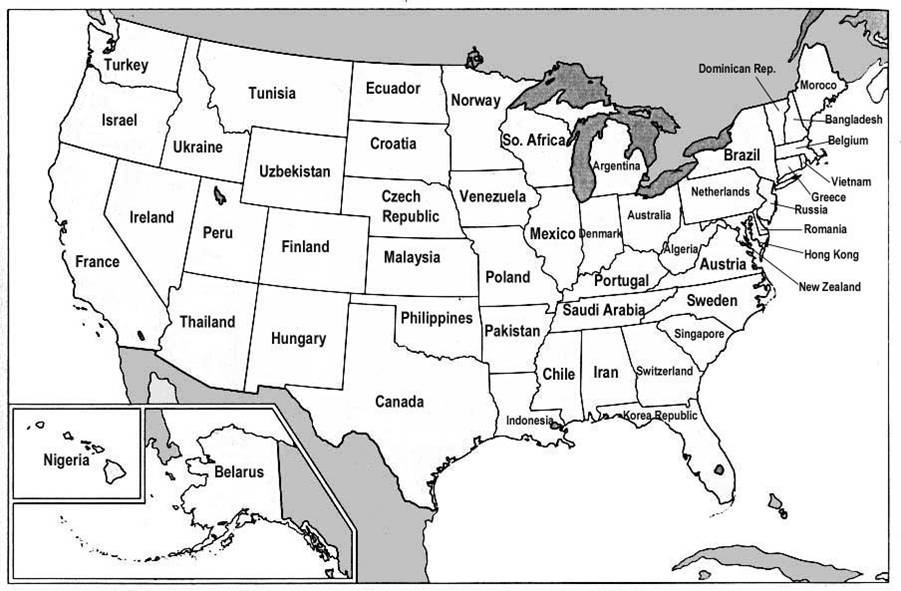
- A picture of the United States labelled with countries most equating each state's GDP.
Germany is moving forward in a number of different areas now that they are the head of the EU. First, Chancellor Merkel is proposing to put the EU Constitution back on track, hoping to approve it by 2009. Second, they are seriously looking at pushing the EU to make strides toward opening up their labour markets for African workers promoting 'circular migration,' hopefully without the negative consequences of their previous 'guest worker' programs. Though not EU related, an article in Der Spiegel notes how, unlike France, Germany is not worried about the 'degradation' of their language from foreign words, noting all the German words that have crept into many world languages.
Also:
- Ahmadinejad is facing increasing pressure at home.
- CSM explains the Shiite-Sunni split.
- NYT examines what $1.2 trillion can do, other than funding the Iraq War. Welcome to opportunity cost.
- A poll taken in Britain shows that most people support the creation of an English Parliament.
- Astronomers have found eight new 'hobbit galaxies' in the Local Group.
- A picture of Earth from 4 billion miles away.
- Choosing between Equate brand and a name brand? Guess what? They're exactly the same.
- Dion stresses the importance of environmental policy.
- Psychology Today looks at how the role of humour is differentiated between the sexes.
- The Telegraph on the decline of the trophy wife.
- A new way to map music using non-Euclidean geometry.
- A picture of the United States labelled with countries most equating each state's GDP.
Monday, January 15, 2007
Britian and France... Up in a tree...
Two interesting historical facts about European politics that I learned this year. First was that during WWII before the French government surrendered to the Germans, Charles de Gaulle attempted to lobby for a political union between the France and Britain against the common German enemy. Now, it turns out that the same thing was proposed again in 1956 by French Prime Minister Guy Mollet during a meeting with British Prime Minister Anthony Eden. Once the appeal for political union was turned down, the French PM then lobbied for France to become part of the Commonwealth. Needless to say, none of this happened, but it is an interesting historical footnote.
Over in Russia, a new law was introduced that prevents any immigrants from seeking jobs in retail trade, which will replace a 40% maximum the police used to target Central Asians and Caucasians in market raids. Johnny Depp is reportedly planning to make a movie based on the life of the life of Alexander Litvinenko, the former Russian spy who was poisoned in London in November.
Also:
- A Pentagon official speaks out against a top law firm that consistently asks to represent to represent Guantánamo Bay inmates, stating that their corporate clients should stop doing business with them because of their commitment to seeing justice done.
- The genetics of sleep.
- Why Europeans are taller than Americans.
- Researchers at York University have found that bilingualism delays dementia.
Over in Russia, a new law was introduced that prevents any immigrants from seeking jobs in retail trade, which will replace a 40% maximum the police used to target Central Asians and Caucasians in market raids. Johnny Depp is reportedly planning to make a movie based on the life of the life of Alexander Litvinenko, the former Russian spy who was poisoned in London in November.
Also:
- A Pentagon official speaks out against a top law firm that consistently asks to represent to represent Guantánamo Bay inmates, stating that their corporate clients should stop doing business with them because of their commitment to seeing justice done.
- The genetics of sleep.
- Why Europeans are taller than Americans.
- Researchers at York University have found that bilingualism delays dementia.
Thursday, January 11, 2007
Big day for Astronomers
Lots of astronomy stuff going on. First, a new gamma-ray observatory is being prepared for launch by NASA. Meanwhile, the existing Chandra X-Ray observatory has observed the reflection of a Mercury-sized object being devoured by the black hole in the centre of our galaxy. New measurements show that the Magellanic Clouds, once thought to be orbital companions of the Milky Way, might actually be independent of our galaxy. India's space programme took a major step launching its first recoverable satellite. A PhD student has hypothesized that the famous 'Pillars of Creation' were destroyed 6,000 years ago by a supernova. However, since they are 7,000 light years away, they still 'exist' for us. Finally, the first triple quasar system has been discovered, previously considered statistically almost impossible.
Also:
- The Russian oil is flowing again through Belarus.
- Today is the 5th anniversary of the use of Guantanamo Bay as a detention facility.
- The US attacks in Somalia may have killed some Canadian citizens.
- Speaking of Canada, the US Defence Department is warning defence contractors about bugged loonies.
- The NYT looks at the the effect of minimum wage laws along state borders with differing minimum wages.
- Four ways the US Congress could stop the war in Iraq, if they really wanted to.
- Judaism starts to go open source.
- Ireland's economy has soared in the past decade, and researchers have found a telling sign of this new prosperity. In a sample of Irish Euro notes, they found that 100% of them contained some trace of cocaine.
Also:
- The Russian oil is flowing again through Belarus.
- Today is the 5th anniversary of the use of Guantanamo Bay as a detention facility.
- The US attacks in Somalia may have killed some Canadian citizens.
- Speaking of Canada, the US Defence Department is warning defence contractors about bugged loonies.
- The NYT looks at the the effect of minimum wage laws along state borders with differing minimum wages.
- Four ways the US Congress could stop the war in Iraq, if they really wanted to.
- Judaism starts to go open source.
- Ireland's economy has soared in the past decade, and researchers have found a telling sign of this new prosperity. In a sample of Irish Euro notes, they found that 100% of them contained some trace of cocaine.
Wednesday, January 10, 2007
Who questions doing something about climate change these days?
The chief economist of Chrysler, apparently, claiming that the Europeans had a 'Chicken Little' view of the problem. This comes as the European Commission is preparing to unveil a new environmental policy including plans for a 20% cut in greenhouse gases from the 1990 levels by 2020. The problem is that he's not completely incorrect. At this point in time, the cost associated with we would have to do to make even a marginal change in increasing temperature would be huge compared to what with could accomplish putting it elsewhere (welcome to opportunity cost). Still, it's this sort of attitude that prevents Americans from doing anything at all, and that's clearly not the optimum strategy.
Meanwhile in Poland the scandal facing the Church over Communist spying continues on, as other priests, including 3 bishops, are accused of similar deeds. A story from the CSM talks about how the massive migration out of Poland and other Central/Eastern European countries has spawned new programmes trying to draw them back. It's an interesting economic experiment in a way, because the shortage of labour (all things being equal, of course) should increase real wages within these countries, making the wage disparity between the West and East more equitable. However, this effect will be depressed by the fact that the people most likely to leave are also the most productive - the economic theory assumes that they migrants are being drawn from a random population, which is likely not the case.
Belarus has given into Russian demands and removed a transit tax on oil shipments, but the effects of the shutdown are still being felt in Europe, leading to a continuing questioning of their current reliance on Russian energy. Der Spiegel has a profile on Semyon Vainshtok, the president of the Russian pipeline company who made the decision.
Also:
- There is apparently a move about by reformers in the Iranian Parliament to impeach President Ahmadinejad.
- More of Germany's attempts to fight neo-Nazi movements.
- European businesses are now more confident in the future than their American peers.
- Britain eyes making a probe to orbit the moon.
- Astronomers have found the first celestial object to have more than two poles.
- The rumour mill has Justin Trudeau contemplating a run for a federal seat in Montréal. Let the love-in begin!
Meanwhile in Poland the scandal facing the Church over Communist spying continues on, as other priests, including 3 bishops, are accused of similar deeds. A story from the CSM talks about how the massive migration out of Poland and other Central/Eastern European countries has spawned new programmes trying to draw them back. It's an interesting economic experiment in a way, because the shortage of labour (all things being equal, of course) should increase real wages within these countries, making the wage disparity between the West and East more equitable. However, this effect will be depressed by the fact that the people most likely to leave are also the most productive - the economic theory assumes that they migrants are being drawn from a random population, which is likely not the case.
Belarus has given into Russian demands and removed a transit tax on oil shipments, but the effects of the shutdown are still being felt in Europe, leading to a continuing questioning of their current reliance on Russian energy. Der Spiegel has a profile on Semyon Vainshtok, the president of the Russian pipeline company who made the decision.
Also:
- There is apparently a move about by reformers in the Iranian Parliament to impeach President Ahmadinejad.
- More of Germany's attempts to fight neo-Nazi movements.
- European businesses are now more confident in the future than their American peers.
- Britain eyes making a probe to orbit the moon.
- Astronomers have found the first celestial object to have more than two poles.
- The rumour mill has Justin Trudeau contemplating a run for a federal seat in Montréal. Let the love-in begin!
Tuesday, January 09, 2007
Russia shuts off the oil
In an escalation of the current dispute over Belarus siphoning oil from a pipeline running through their country from Russia in retaliation for doubling their gas prices, Russia has counter-retaliated by cutting off the oil supply to Belarus, and therein Western Europe as well. It was initially reported that Belarus was the cause of the shut down, but the Belarus government claims that the stoppage comes from Russian soil. German Chancellor Merkel declared this sudden interruption of oil as "unacceptable," and many German newspapers mulled over the reliability of Russia as a trading partner and their reliance on foreign energy.
In other news:
- Scientists believe that many differing physical characteristics are not caused just by genes themselves, but in variations in their expression.
- Psychology Today talks about how conservatives and liberals are different in many things other than their political opinion.
- Italy considers what to do about 25 CIA agents accused of kidnapping a Muslim cleric within its borders and sending him to Egypt to be tortured.
- Slate weighs in on the Polish archbishop scandal.
- A modification of the burqa allows Australian Muslim women to serve as lifeguards.
- The BBC on how spicy foods can kill cancer cells.
- With the Democrats proposing an increase in the minimum wage, the Christian Science Monitor looks at what it's like to live on the current minimum wage.
In other news:
- Scientists believe that many differing physical characteristics are not caused just by genes themselves, but in variations in their expression.
- Psychology Today talks about how conservatives and liberals are different in many things other than their political opinion.
- Italy considers what to do about 25 CIA agents accused of kidnapping a Muslim cleric within its borders and sending him to Egypt to be tortured.
- Slate weighs in on the Polish archbishop scandal.
- A modification of the burqa allows Australian Muslim women to serve as lifeguards.
- The BBC on how spicy foods can kill cancer cells.
- With the Democrats proposing an increase in the minimum wage, the Christian Science Monitor looks at what it's like to live on the current minimum wage.
Monday, January 08, 2007
A hodge-podge of different stuff
The oil row between Russia and Belarus is beginning to effect the EU, as supply to Poland and Germany drops by 20%. Meanwhile, Georgian fruit-farmers are fighting back, blocking the main route between North Ossetia and South Ossetia in protest of the Russian ban on imports that were imposed a year ago. This all comes during an 10-day holiday period in Russia during the first week of the new year, where the leisure time increases the crime rate dramatically and points out the increasing economic disparity between the poor and the well-off. Another story illustrates the increasing discrimination and ethnic tension Muslims are facing in Russia.
In astronomy, scientists have constructed a hypothetical 3D map of dark matter using observations made by the Hubble space telescope. On the flip side, a Washington State University professor claims that the initial searches for life on Mars may have inadvertently killed the life they were looking for. Despite the amount of research done on using genes to cure diseases, other scientists are now looking for sequences of DNA that ensure that life will not happen. Since I'm studying international politics, massive fights over methodology (and epistemology) are nothing new to me, and this paper talking about some of the methodological Balkanisation in the biological sciences with regards to new techniques at least makes me feel like we're not the only ones.
In other news:
- The top 10 foreign policy stories you might have missed in 2006, according to Foreign Policy.
- Far-right MEPs in the European Parliament are joining together to increase their political power, as a German town successfully banded together to drive out neo-Nazi extremists.
- Leaked documents state that Israel planned to bomb Iranian nuclear sites with nuclear weapons - or did they?
- The New Yorker looks at the rhetoric versus the reality of Chávez's Venezuela.
- A Guardian piece about Afghan families who sell their pre-pubescent daughters as brides in order to feel the family.
- If you were lucky enough to make over $1 million this year, you also were lucky enough to gain the most from the Bush tax cuts.
- China is flying high economically, but high levels of corruption may take the shine out of the growth.
- After the resignation of an archbishop for Communist spying, Der Spiegel takes a look at the changing relationship of Poles to the Catholic Church.
- Slate examines the issue of cloned food.
- The American Dialectical Society claims that 'plutoed,' or to to demote or devalue
someone or something, is the word of the year. (pdf)
- Thanks to the Wii, video games might now actually be good for you.
In astronomy, scientists have constructed a hypothetical 3D map of dark matter using observations made by the Hubble space telescope. On the flip side, a Washington State University professor claims that the initial searches for life on Mars may have inadvertently killed the life they were looking for. Despite the amount of research done on using genes to cure diseases, other scientists are now looking for sequences of DNA that ensure that life will not happen. Since I'm studying international politics, massive fights over methodology (and epistemology) are nothing new to me, and this paper talking about some of the methodological Balkanisation in the biological sciences with regards to new techniques at least makes me feel like we're not the only ones.
In other news:
- The top 10 foreign policy stories you might have missed in 2006, according to Foreign Policy.
- Far-right MEPs in the European Parliament are joining together to increase their political power, as a German town successfully banded together to drive out neo-Nazi extremists.
- Leaked documents state that Israel planned to bomb Iranian nuclear sites with nuclear weapons - or did they?
- The New Yorker looks at the rhetoric versus the reality of Chávez's Venezuela.
- A Guardian piece about Afghan families who sell their pre-pubescent daughters as brides in order to feel the family.
- If you were lucky enough to make over $1 million this year, you also were lucky enough to gain the most from the Bush tax cuts.
- China is flying high economically, but high levels of corruption may take the shine out of the growth.
- After the resignation of an archbishop for Communist spying, Der Spiegel takes a look at the changing relationship of Poles to the Catholic Church.
- Slate examines the issue of cloned food.
- The American Dialectical Society claims that 'plutoed,' or to to demote or devalue
someone or something, is the word of the year. (pdf)
- Thanks to the Wii, video games might now actually be good for you.
Subscribe to:
Posts (Atom)